
Part of our ongoing work with the RSA’s nationally significant collections involves remedial conservation to return artworks as much as possible to their original condition and what the artist intended them to look like. Preventive conservation involves ensuring that conditions are in place to prevent artworks from deteriorating, but remedial conservation is designed to intervene when an artwork has already deteriorated and needs attention. All artworks deteriorate over time, some more than others. With a collection of many thousands of things, a long-term care and conservation strategy is required to preserve and direct attention when and where it is needed. Depending on the type of deterioration, artworks can be at risk if they are not treated, while in other cases they remain stable, but don’t look particularly good and cannot be exhibited.

David Octavius Hill RSA (1802-70) and Robert Adamson (1821-48), Thomas Duncan RSA standing, c. 1843-48, calotype. RSA collections (gifted by D O Hill RSA) (1993.392)
Projects and exhibitions often raise the priorities for conservation and our recent exhibition Origin Stories provided the opportunity to bring a past masterpiece by Thomas Duncan RSA out of the shadows. Duncan’s painting of sculptural casts from the Trustees Academy sculpture gallery in the Royal Institution building (now the RSA building) is significant in its relationship with the early teaching of art in Scotland, in which the RSA was deeply involved. Duncan was taught at the Trustees’ Academy by Sir William Allan PPRSA and he went on to teach at the Trustees’ Academy and the RSA Life School, becoming master of the former in 1844 just before his early death.

William Drummond Young (1854-1924), Interior of the Cast Gallery of the Edinburgh School of Art [formerly The Trustees' Academy] in the Royal Institution Building, c. 1890-99, photograph, RSA Archives (2025.0126)
In terms of condition, sometimes paintings can look worse than they are, and this was the case with the Duncan due to a heavy layer of surface dirt. Although the RSA collections are now stored down at Granton Art Centre, they used to be in store at the Mound, and the build-up of soot over a century in Auld Reekie was often considerable in the centre of the city. But fortunately, surface dirt is easy to remove with modern conservation and can result in amazing transformations, as the treated painting shows.

After Conservation - Thomas Duncan RSA (1807-45), Study of Casts in the Trustees’ Academy, c. 1827-30, Oil on canvas. RSA collections (Purchased from David Ramsay Hay's collection, 1866-7) (1993.128)
Tricky decisions also need to be made in conservation, and current practice guides us to notninterfering any more than necessary and to make any treatments completely reversible in case of new research or future discoveries. Many will be aware of recent restoration disasters where irreversible damage has been done to past masterpieces!

Details - Thomas Duncan RSA (1807-45), Study of Casts in the Trustees’ Academy, c. 1827-30, Oil on canvas. RSA collections (Purchased from David Ramsay Hay's collection, 1866-7) (1993.128)
With the Duncan, this meant leaving the islands of paint in the background that are the result of drying and shrinking bituminous paint (a favourite pigment of the nineteenth century that gave a rich velvety black). Retouching this area would have introduced an unacceptable degree of non-original paint to the canvas, a definite no-no.


Damaged frame details and putty moulds
The final challenge with the Duncan painting was that its original frame was also damaged and like the painting, was exceptionally dirty. It was missing parts of the gilt ornament and other sections were loose and vulnerable. For the painting to be returned to its earlier splendour, the original frame also needed treatment, but again modern conservation came to the rescue in the form of consolidating, cleaning and making putty moulds to create new gesso parts for the frame moulding.

Thomas Duncan RSA (1807-45), Study of Casts in the Trustees’ Academy, c. 1827-30, Oil on canvas. RSA collections (Purchased from David Ramsay Hay's collection, 1866-7) (1993.128)
As an independent institution, the RSA has no in-house conservation department and we are indebted to the services of Owen Davison and Colleen Donaldson at The Conservation Studio in Edinburgh for painting and frame conservation. We are also indebted to the RSA Patrons for their financial support in the conservation of our Recognised Collection of National Significance to Scotland. It is through their help that we are able to return masterpieces in our collections to their former glory.
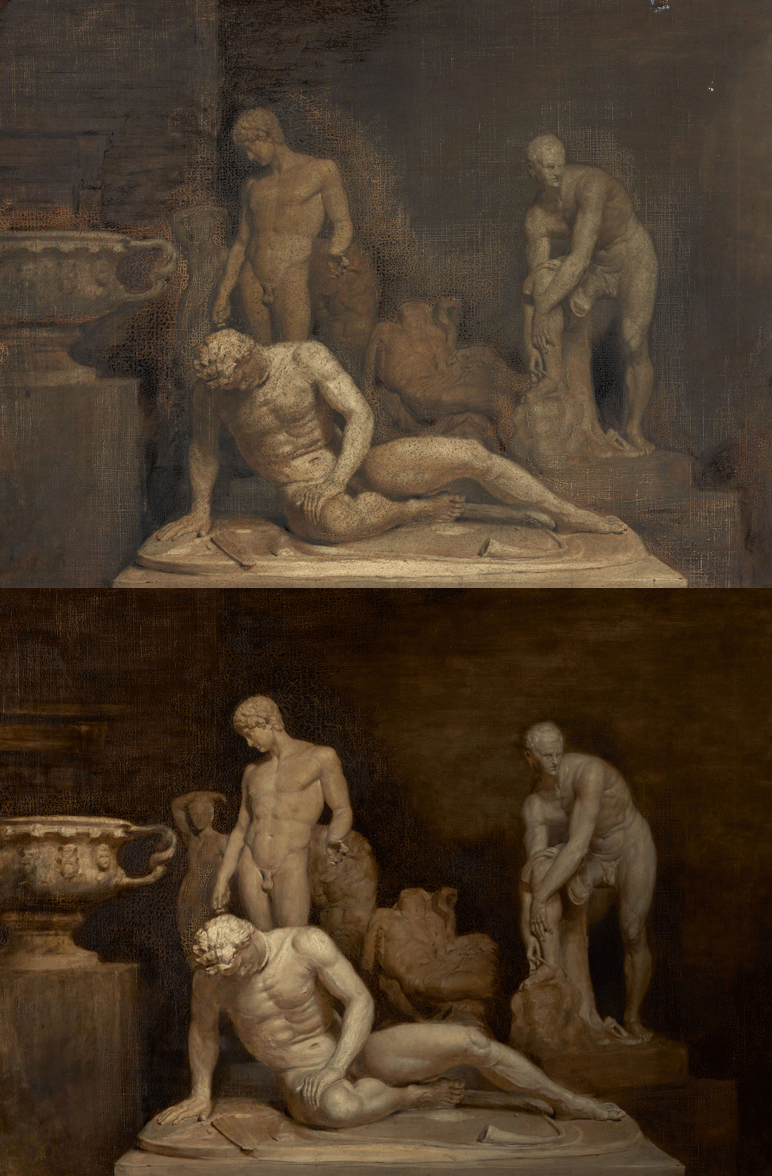
Before and after - Thomas Duncan RSA (1807-45), Study of Casts in the Trustees’ Academy, c. 1827-30, Oil on canvas. RSA collections (Purchased from David Ramsay Hay's collection, 1866-7) (1993.128)
About the author

Sandy Wood
Sandy Wood is Head of Collections at the RSA. He is responsible for the management, care of, and access to the RSA’s uniquely formed collection, Recognised as a collection of National Significance to Scotland.
Sandy joined the RSA in 2003 after graduating in Fine Art from Gray’s School of Art, Aberdeen, later completing a Masters in Museum Studies at the University of Leicester. Of particular interest to him are the stories woven between historic and contemporary practice and practitioners, artistic lineage and legacy, and the revealing of art through process and artistic voice.
