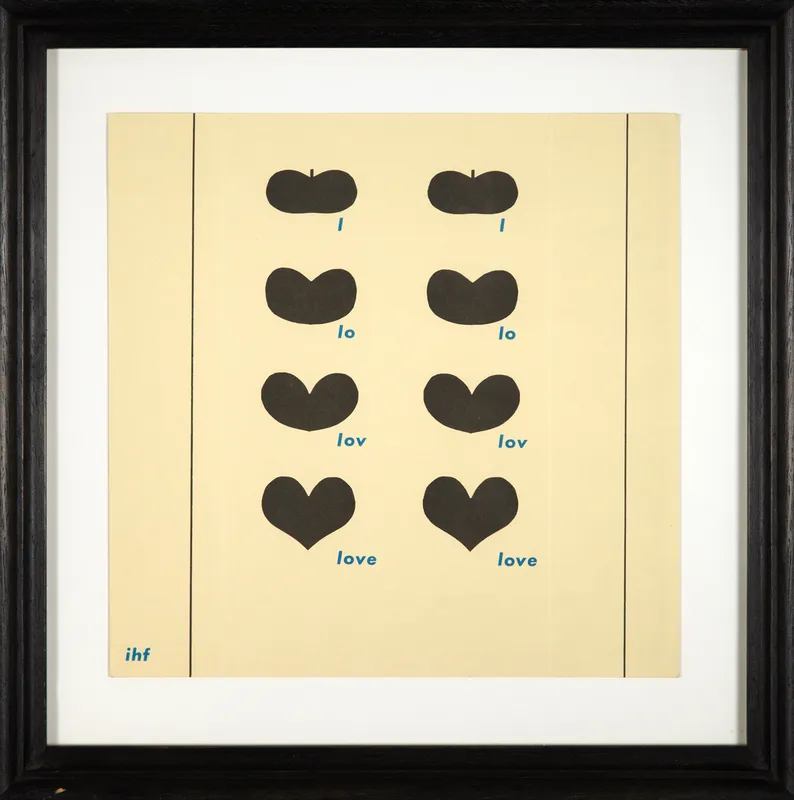
Ian Hamilton Finlay HRSA
Ian Hamilton Finlay (1925–2006) was a Scottish poet, visual artist, and garden designer internationally recognised for blending language, sculpture, and landscape into a distinctive and influential body of work.
Born in Nassau, Bahamas, to Scottish parents, Finlay was educated in Scotland and briefly attended Glasgow School of Art before beginning his career as a writer. He first gained prominence in the 1960s as one of Britain’s leading concrete poets, a form of poetry wherein the layout and typography of the words inform the meaning of the poem. Finlay later expanded his practice to include sculpture, graphic works, inscriptions, and environmental installations.
Finlay’s art is characterised by semantic brevity, formal inventiveness, wit, and a sustained exploration of the relationship between civilisation and violence, order and chaos, and culture and nature. Recurring themes in his work include the sea, classical literature (especially Virgil), revolution, war, and the enduring tension between creation and destruction. Although increasingly known as a sculptor, language remained central to his practice, with poems often carved into stone or integrated into architectural and natural settings.
In 1966, Finlay moved with his wife Sue to Stonypath in the Pentland Hills near Edinburgh, where they developed the celebrated garden Little Sparta. Conceived as a Gesamtkunstwerk (total work of art), Little Sparta combined sculpture, inscription, landscape design, and natural elements into a living poetic environment and became the epicentre of his creative life. Shortlisted for the Turner Prize in 1985 and appointed CBE in 2002, Finlay is regarded as one of the most significant figures in twentieth-century Scottish art, whose work uniquely fused poetry and visual form.
Finlay was made an Honorary member of the Royal Scottish Academy in 2005.
